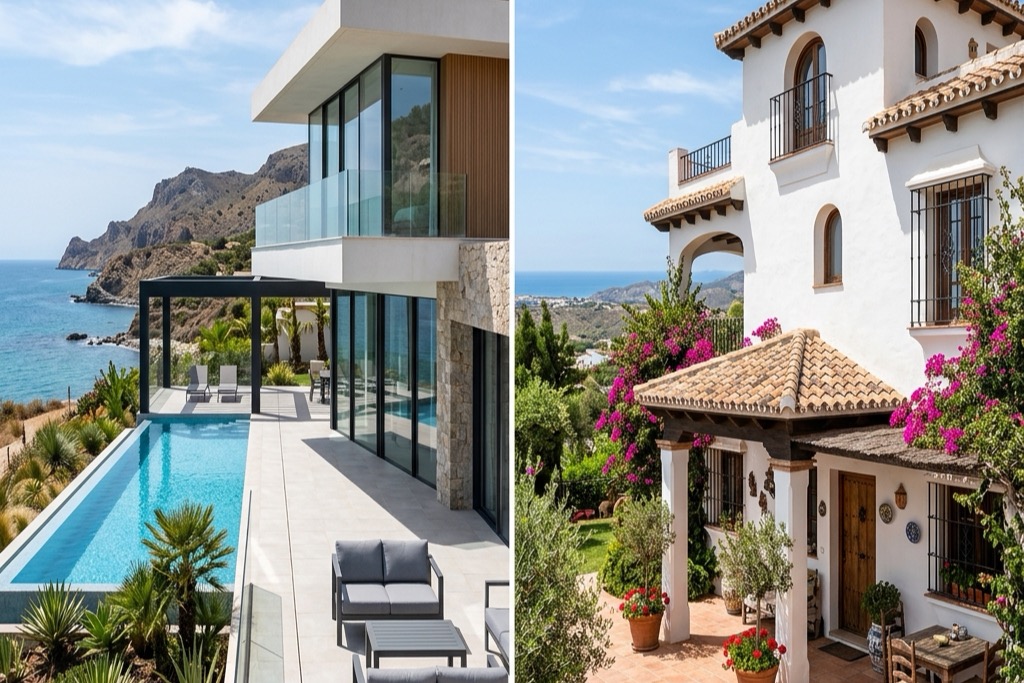
When searching for a property on the Costa del Sol, buyers are faced with a fundamental choice: should they buy a brand-new development (often off-plan or recently completed) or a resale property (a second-hand home in an established neighborhood)? Both options have significant appeal, but they represent entirely different paths in terms of purchase taxes, legal timelines, and bank financing.
Securing a Spanish mortgage for a new-build property involves a different underwriting process and timeline than for a resale property. This guide breaks down the tax rules, compares the mortgage application structures, and highlights the pros, cons, and risks of each route so you can plan your budget accurately.
The tax divergence: IVA vs ITP
One of the most significant differences between new builds and resales is the tax regime. These taxes are paid on top of your deposit and cannot be added to the mortgage principal. Lenders expect you to cover them with cash.
| Cost Component | New Build / Off-Plan | Resale (Second-Hand) |
|---|---|---|
| Primary Tax | 10% IVA (VAT) | ITP (Transfer Tax) |
| Andalusia Tax Rate | Flat 10% of purchase price | Flat 7% of purchase price |
| Secondary Tax | AJD (Stamp Duty) — typically 1.2% in Andalusia | None |
| Total Tax Load | Approximately 11.2% | Flat 7% (ranging 7%–10% elsewhere in Spain) |
This shows that a new-build property carries a higher tax burden. For a €400,000 purchase on the Costa del Sol, buying resale requires €28,000 in transfer tax, whereas a new-build requires €44,800 in VAT and stamp duty. Ensure you calculate these figures into your cash reserve requirements before applying for your loan. For a complete breakdown of notary, land registry, and legal fees, see our guide on the cost of buying property in Spain.
Mortgage processes: Immediate completion vs off-plan stages
The timeline and mechanics of getting your loan approved differ significantly between the two property types:
Resale Property (Immediate Transaction)
The mortgage process is linear and immediate. Once your offer is accepted and you sign the Arras (deposit) contract, you submit your financial documents to the bank. Lenders order a physical valuation (tasación) of the property. Underwriting takes 2 to 4 weeks, and you complete the purchase at the notary shortly after. The mortgage is signed and funds are released simultaneously with the property deed.
New Build / Off-Plan Property
Buying off-plan means you sign a contract for a property that may not be completed for 12, 18, or 24 months. During construction, you typically pay the developer **20% to 30% of the price in stage payments** using your own savings. The bank mortgage is only signed at completion, when the developer receives the License of First Occupation (LFO).
This introduces a major financing risk: banks do not issue binding mortgage approvals 18 months in advance. Lenders will review your financial profile when you sign the reservation contract to give an "indicative approval," but the formal underwriting and valuation can only happen when the building is completed. If your income, employment status, or interest rates change in the intervening period, your final loan offer could be different.
Advantages of new-build properties
- No refurbishments needed: The property is ready to move in, reducing secondary cash requirements.
- Builder Guarantees: Under Spanish law (LOE), new-builds come with structural guarantees (10 years for structural defects, 3 years for installations, 1 year for finishes).
- High energy efficiency: Modern builds have excellent insulation, solar panels, and double glazing. This is highly relevant for financing: **some Spanish banks offer "green mortgages"** with lower interest rates or discounted arrangement fees for properties with an A or B Energy Performance Certificate (EPC).
Advantages of resale properties
- Consolidated locations: Resale properties are often in prime, city-centre, or established beachside locations where new-build land is unavailable.
- Lower purchase cost per square metre: You often get more space for your budget, even factoring in the cost of a future renovation.
- Immediate Availability: You can move in or begin renting the property out immediately after completion at the notary, avoiding the 2-year construction wait.
Managing off-plan risks
If you choose to buy off-plan, protect your capital by ensuring all stage payments delivered to the developer during construction are protected by a **bank guarantee (aval bancario)**, as required under the Spanish Building Act (LOE). If the developer faces insolvency or construction is significantly delayed, this guarantee ensures the return of your deposits. Your independent lawyer will verify that these guarantees are issued for every payment.
Before committing to a reservation fee, we recommend calculating your borrowing limits. Use our Spanish mortgage calculator to model different scenarios and estimate your monthly payments.
Can I get a mortgage for an off-plan property before it's built?
No. Spanish banks cannot issue a binding mortgage offer or release funds for an off-plan property until it is fully completed and has received its License of First Occupation (LFO). Lenders will only perform the formal underwriting and physical valuation (tasación) in the final 2 to 3 months before completion. You must cover all intermediate payments using your own funds.
Is VAT included in the mortgage financing or paid separately?
VAT (10% IVA) is a transaction cost and is paid separately. Spanish banks calculate the maximum loan amount (LTV) strictly on the net purchase price or valuation — excluding VAT, stamp duty, notary, and registry fees. You must ensure you have sufficient cash savings to cover the deposit plus the ~11.2% tax load on new builds.